TRAVEL NOTES / NO. 001
WEDNESDAY, AUGUST 19, 2026
Travel Stories · 4 MIN READ112
A solo traveler pauses at the door of a Korean barbecue restaurant
Korean barbecue once required orders for two or more — here is how solo diners are finding their way in
By Find to Send Editorial
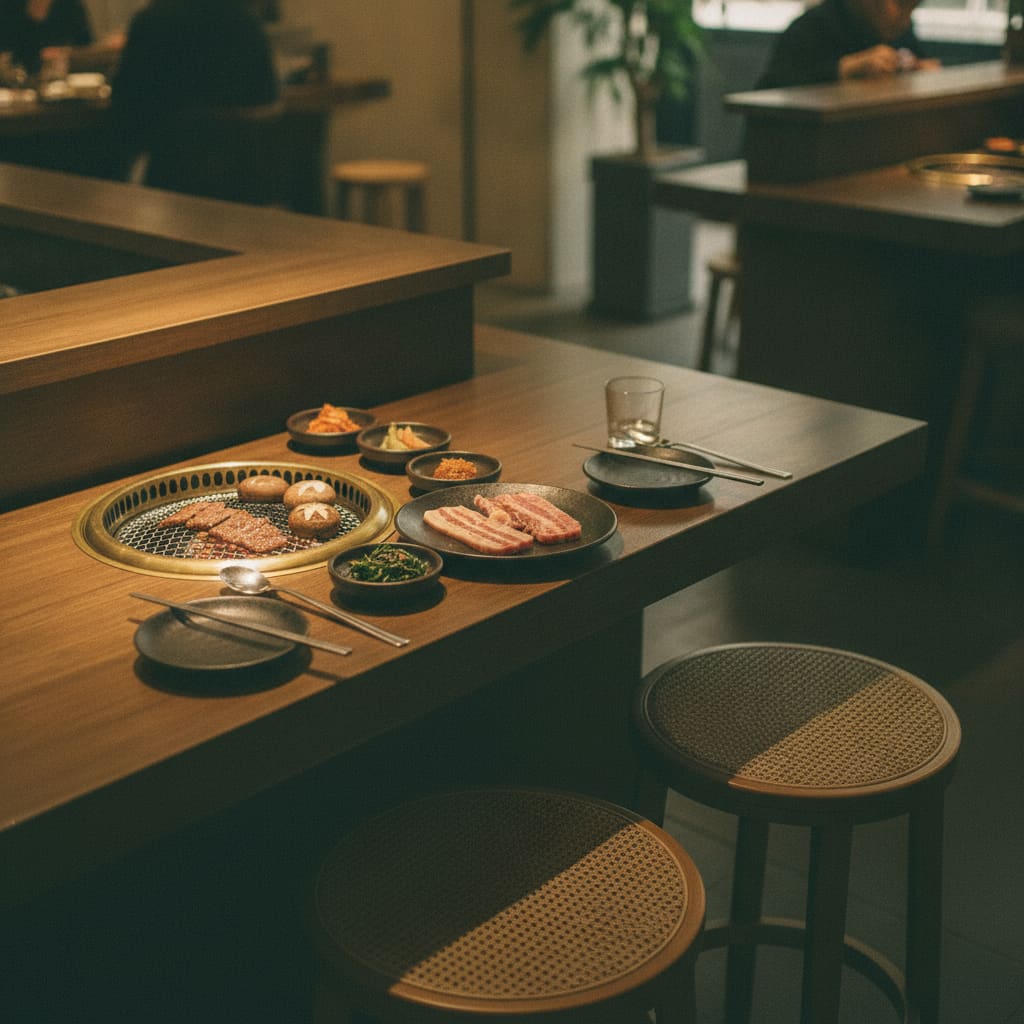
Six in the evening, a narrow alley in Seoul. Smoke and the smell of grilled meat drift out into the street, and a traveler pauses at the door of a barbecue restaurant. Through the glass, groups of two and three sit clustered around sizzling grills, laughter rising above the smoke. No one seems to be eating alone. Flipping through the menu propped outside, there is no single-portion price listed anywhere. Is it worth walking in, or will it just mean standing there feeling out of place.
This brief hesitation is something many foreign travelers experience at least once in Korea. Korean-style barbecue took shape as a communal meal, several people gathered around one grill sharing the same portions, and that cultural momentum still shows up in how menus are structured. Plenty of solo travelers linger at the door for a moment and then simply walk away.
Step inside, though, and the picture sharpens. A hand-written menu taped beside the counter, a butane gas grill sitting on every table, a small sign on the wall reading 'orders for two or more.' The staff's eyes go straight to counting how many people are in the group. If you only learn that single-portion orders are not accepted after you have already sat down and opened the menu, the awkwardness doubles. Standing back up and walking out is a heavier thing to do than it sounds.
The real problem is not simply that solo orders are refused, but that there is rarely an easy way to know this in advance. Without foreign-language signage, the menu alone often gives no clue about single-portion availability, and when language is a barrier, asking a staff member first can feel intimidating. Many travelers end up caught between two uncertain choices: walk in and hope for the best, or give up and search for somewhere else entirely.
Understanding why this practice still persists makes it easier to accept. The cost structure of a traditional Korean barbecue restaurant is built around multiple portions being grilled together. Side dishes, lettuce wraps and dipping sauce, a pot of soybean paste stew, these are often set on the table as standard regardless of headcount, which means selling only one portion rarely covers ingredient costs. Dedicating a whole grill and table to a single diner has also long been seen as a loss in terms of table turnover. Over time, this arithmetic hardened into the standard practice of requiring orders for two.
But in the past several years, as solo dining has become an ordinary part of Korean life, this calculation has begun to shift, especially at restaurants that opened more recently. Single-seat counters, compact personal grills, and menus with dedicated single-portion pricing are all becoming more common. These places tend to display phrases like 'solo dining welcome' near the entrance or on the menu itself. Knowing this pattern, that older, established restaurants tend to hold firmly to the two-portion rule while newer ones are more likely to welcome solo diners, makes that brief moment of scanning the storefront much easier to navigate.
So what should you actually check, either from outside the door or before you sit down.
- Scan the entrance and menu board first. Look for phrases like 'solo dining okay' or a listed single-portion price; this alone often settles the question without needing to ask anyone.
- If it is unclear, ask before you sit down. Holding up a single finger while saying something as simple as 'one person' is usually enough to communicate, and the staff's expression or reply will tell you immediately whether it works. Confirming this before sitting is far less awkward than finding out after.
- At places where two portions really are the minimum, taking the leftovers to go is a perfectly normal option rather than forcing yourself to finish everything alone. Asking for a takeout box is completely unremarkable in Korea and is often seen as simply being practical.
- If eating alone without any friction matters most, it is easier to choose places built with solo diners in mind from the start. Barbecue franchise chains, food courts in large shopping malls, and the ready-to-eat corners of convenience stores were all designed with single customers in mind, so there is almost no need to worry about how it will be received.
- Until this all feels more familiar, choosing an earlier hour or a quieter time slot rather than peak dinner hours can help as well. Staff at a less busy restaurant tend to have more flexibility and are often more willing to accommodate a single order.
Back at that alley. The traveler eventually pushes the door open and holds up one finger. The staff member points briefly at the menu, explains something, and soon a small personal grill is set down at the table. Being alone stops being the problem. Eating by yourself in an unfamiliar country turns out to be less about memorizing rules and more about finding the nerve to ask one short question.
Read next
OCT 7, 2026 · Travel Stories
The broth is free before anything else: a small lesson in Seoul's street tents
OCT 4, 2026 · Travel Stories
There's no restaurant in sight, so how does the fried chicken arrive at the Han River
SEP 26, 2026 · Travel Stories