TRAVEL NOTES / NO. 055
WEDNESDAY, OCTOBER 7, 2026
Travel Stories · 3 MIN READ83
The broth is free before anything else: a small lesson in Seoul's street tents
A few skewers and a cup of broth are usually enough for the night — many tents take cards now, but a little cash in your pocket still helps
By Find to Send Editorial
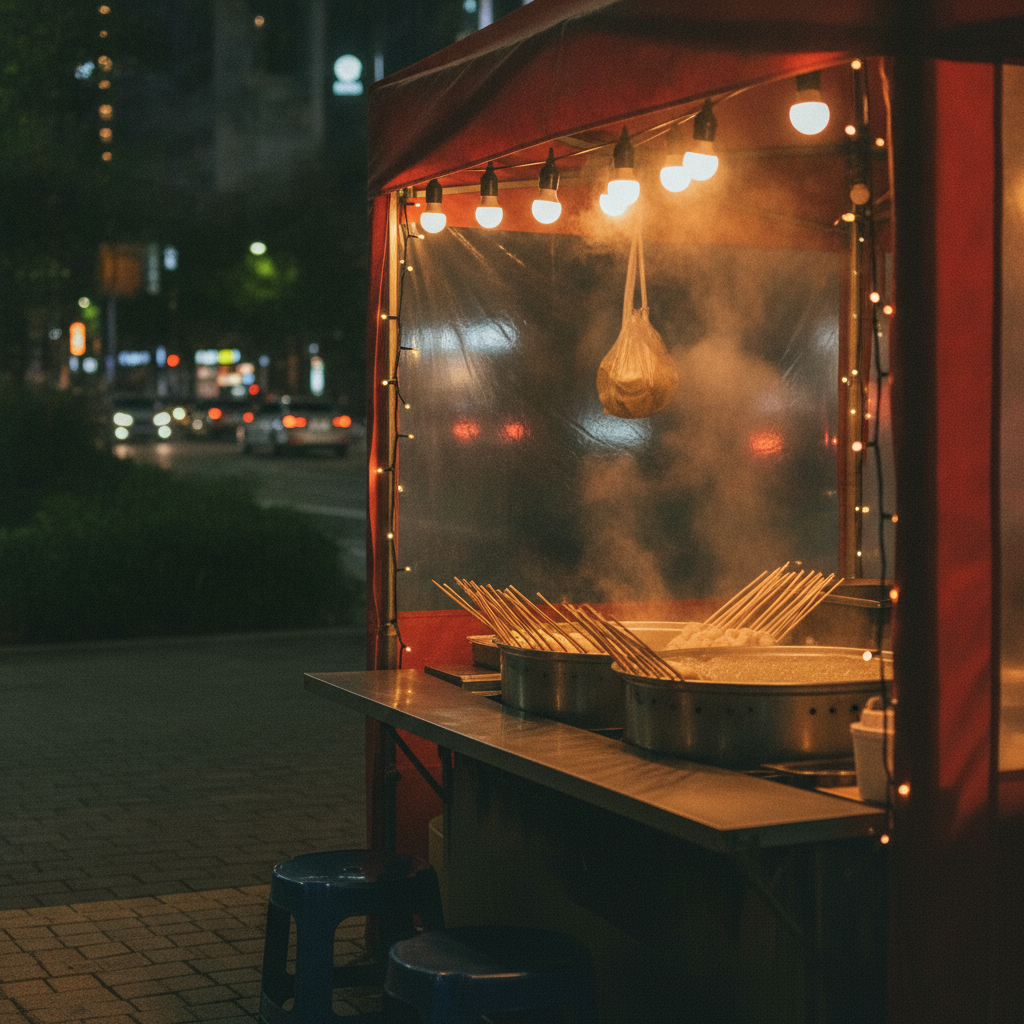
Eleven at night, a back alley near Jongno. Steam rises inside a plastic tent, and someone perched on a low stool is already pouring broth into a paper cup — without paying for it. A first-time visitor hesitates for a second: is this actually free to drink.
Inside the cramped tent, people stand shoulder to shoulder with others seated on stackable stools. Skewers of odeng stand in rows in a large aluminum pot, while tteokbokki simmers red on a griddle nearby. The owner tracks how many skewers each customer has eaten just by watching. There is no menu board, no register. Everything runs on word and eyesight.
Two things trip up travelers here. One is simply not being sure whether the broth is free. The other comes at the end: how to pay. Many stalls take cards these days, but some small tents may not have a terminal, and finding that out after you have eaten is no fun.
Pojangmacha tents began not as shops but as mobile carts and single tents run by people making a living day to day. For a long time, settling everything in cash made more sense than installing card terminals, wiring, and reconciliation systems. Many tents accept cards today, but that history still shows in some of them. The free broth follows the same logic — it was never really a product, just the leftover liquid from boiling the skewers, offered as a small, wordless hospitality that keeps people lingering.
So walking into a pojangmacha, this is roughly how it goes.
- Many tents take cards these days, but just in case, bring some small bills and coins — the smaller the stall, the likelier it is to lack a terminal.
- Eat the odeng skewer by skewer, and either stand the empty sticks up for the owner to see or just leave them as they are until counted.
- Help yourself to the broth. If it is your first time, it does not hurt to watch how the people around you do it.
- Tteokbokki and other dishes are usually priced per serving, so a quick gesture before ordering works fine.
- Settle the whole bill at the end. Ask whether cards are accepted first; if not, pay with the cash you brought.
That night, it was only after the first sip from the paper cup that it became clear — hospitality here was never a grand service, just a bowl of broth handed over without a word.
Read next
OCT 4, 2026 · Travel Stories
There's no restaurant in sight, so how does the fried chicken arrive at the Han River
SEP 26, 2026 · Travel Stories
One shark trapped in a narrow canal drew more crowds to Busan than a 70-billion-won expo in Yeosu
SEP 24, 2026 · Travel Stories