TRAVEL NOTES / NO. 025
WEDNESDAY, SEPTEMBER 9, 2026
Korea Travel · 5 MIN READ97
The kimchi bowl is empty. Do you dare raise your hand
Side dishes are usually refilled for free in Korean restaurants, but not everything is, and knowing the line in advance makes the meal easier
By Find to Send Editorial
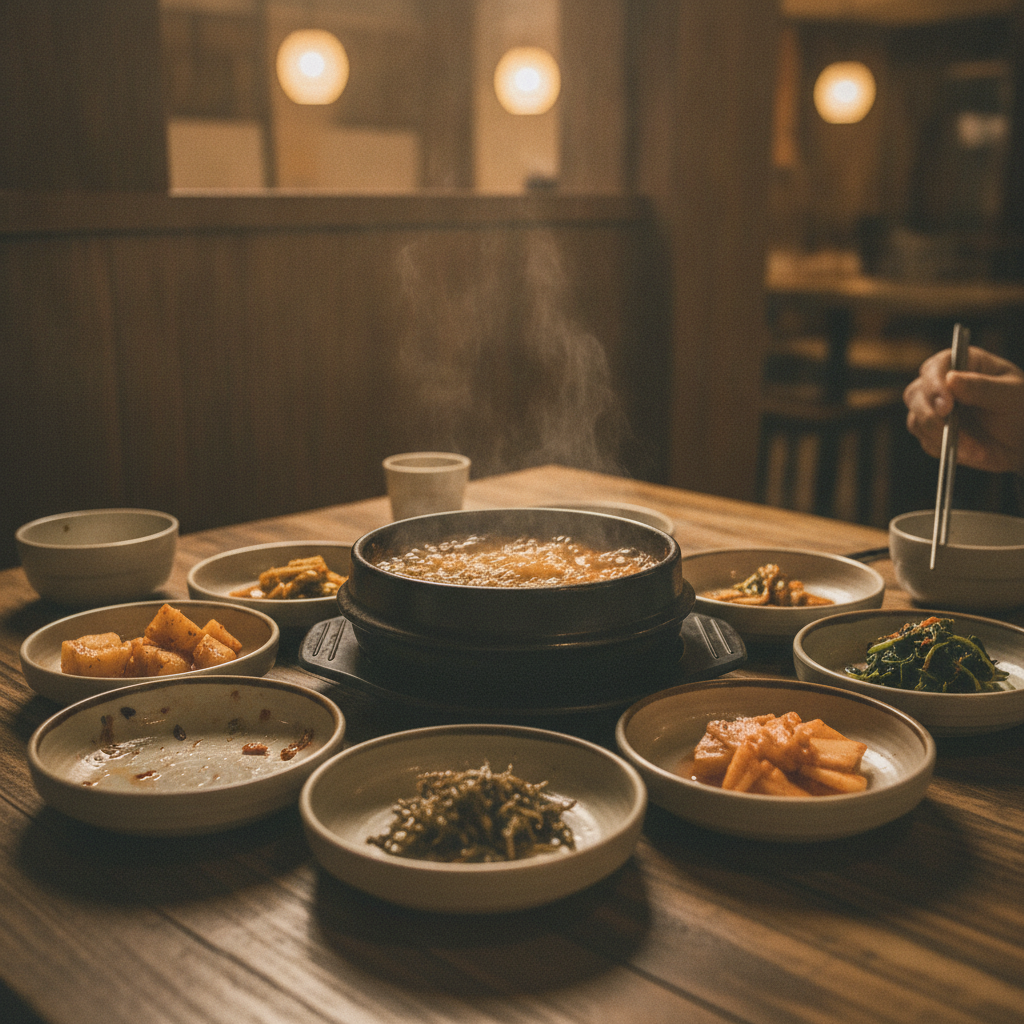
One last piece of kimchi sits alone on the plate. As you scrape the bottom with your chopsticks, the Korean customer at the next table wordlessly lifts an empty dish and gives it a small shake, and the server comes over and refills it without a word. Nothing new appears on the bill. Watching this, you find yourself wondering whether you are allowed to do the same, or whether that was some kind of regular's privilege.
In Korean restaurants, side dishes sit in a permanently ambiguous zone. The main dish is clearly something you pay for, and water or wet wipes are clearly free. But in between sit things like kimchi, bean sprouts, seasoned squid, or rolled egg, and menus rarely spell out whether these are free or not. So travelers pick up their chopsticks only half sure of the rules.
At a home-style rice restaurant in Seoul, lunch hour has the table already crowded with small stainless dishes: seasoned bean sprouts, spinach namul, stir-fried anchovies, two kinds of kimchi. At the next table, a customer nudges an empty dish toward the server with nothing more than a glance. The dish is refilled without a single word exchanged, and the server is already moving to the next table. The motion is so smooth it looks like a rhythm repeated thousands of times in this same room.
On the handwritten menu taped to the wall, though, it says steamed egg five thousand won, extra stir-fried pork ten thousand won. This is clearly a different category from the side dishes. Yet some of the dishes already on the table, like rolled egg, look just as carefully made as anything on that handwritten list, and there is often no visual way to tell whether something is a free side or a paid extra.
The real problem is that this line is unclear both visually and linguistically. To a traveler who does not read Korean, every dish on the table can look like part of the restaurant's hospitality. Some travelers have pointed at a rolled-egg dish asking for more, only to be surprised later by an unexpected charge on the bill. Others swing the opposite way, quietly rationing themselves on kimchi they were entitled to refill for free, worried that asking might look presumptuous.
This ambiguity feels especially uncomfortable because the custom was never meant to be explained in words in the first place, it was meant to be absorbed by habit. Korean diners learn the difference between staple side dishes and separately ordered items simply by eating out for years, starting in childhood. They can often tell just from the name on the menu, the size of the dish, or how it is plated, whether something is free or paid. But that instinct is accumulated experience, not a written rule, so there is no obvious way to pass it on to a first-time visitor.
Looking deeper, this custom rests on the old structure of the Korean table setting. Whether it is a full course meal or a simple home-style plate, a Korean meal was traditionally built around rice and soup, surrounded by a ring of side dishes. Those side dishes existed to support the main components of the meal, not to stand as separate products in their own right. So it made more sense for restaurants to treat them as part of the meal already covered by the rice price, rather than as items with their own price tags. This is also why dishes that are easy to make in bulk and keep in storage, like kimchi or namul, tend to be the ones refilled for free. Dishes that require fresh cooking to order and carry higher ingredient costs, like rolled egg or stir-fried pork, are structurally different, even if they look like side dishes on the table, so they get priced separately.
There is also a practical business reason behind this. Offering unlimited free refills on side dishes is an old expression of generosity toward guests, but that cost is already quietly folded into the price of the main dish. Restaurant owners can afford to be generous with low-cost, bulk-cooked items like kimchi and namul precisely because they draw a firm price line around labor-intensive dishes elsewhere. The border between free and paid, then, is not arbitrary, it is the result of ingredient cost, cooking time, and centuries-old table conventions layering on top of each other.
So what should a traveler actually do to avoid confusion.
- Assume the dishes that arrive on the table the moment you sit down are free. Kimchi, namul, bean sprouts, pickled radish, stir-fried anchovies served in small stainless dishes are refilled free almost without exception.
- When you want a refill, there is no need for a long sentence. Lifting the empty dish slightly or catching the server's eye while pointing at it is more than enough, and this small gesture is understood in nearly every restaurant regardless of language.
- Anything listed separately with its own price, on the menu or a handwritten sign on the wall, is clearly paid. Steamed egg, an extra portion of stir-fried pork, an extra serving of noodles, if a specific name comes with a specific price, treat it as its own order rather than a side dish.
- In ambiguous cases, for instance when something already on the table looks unusually elaborate or is served in a smaller portion than the other side dishes, it is safer to ask briefly before ordering more. Pointing at the dish with a simple questioning expression is usually enough for a server to answer with a smile.
- If you are still not sure, you can simply wait until the bill arrives to check. Most Korean restaurants do not add charges for refilled side dishes, so the final bill is often simpler than travelers expect.
Back at that rice restaurant, the traveler cautiously lifted the empty kimchi dish just slightly. The server refilled it with a smile and no comment, and the bill, when it came, still showed only the price of the original order. In that moment, it becomes clear that the boundary around side dishes is not a rule learned from words, but a sense absorbed the first time you actually try it.