TRAVEL NOTES / NO. 014
FRIDAY, AUGUST 28, 2026
Travel Problems · 3 MIN READ68
The airport exchange line is gone. One card raises a new question.
Neither cash nor credit card, WOWPASS offers a third option — here is exactly what it solves, and what it does not.
By Find to Send Editorial
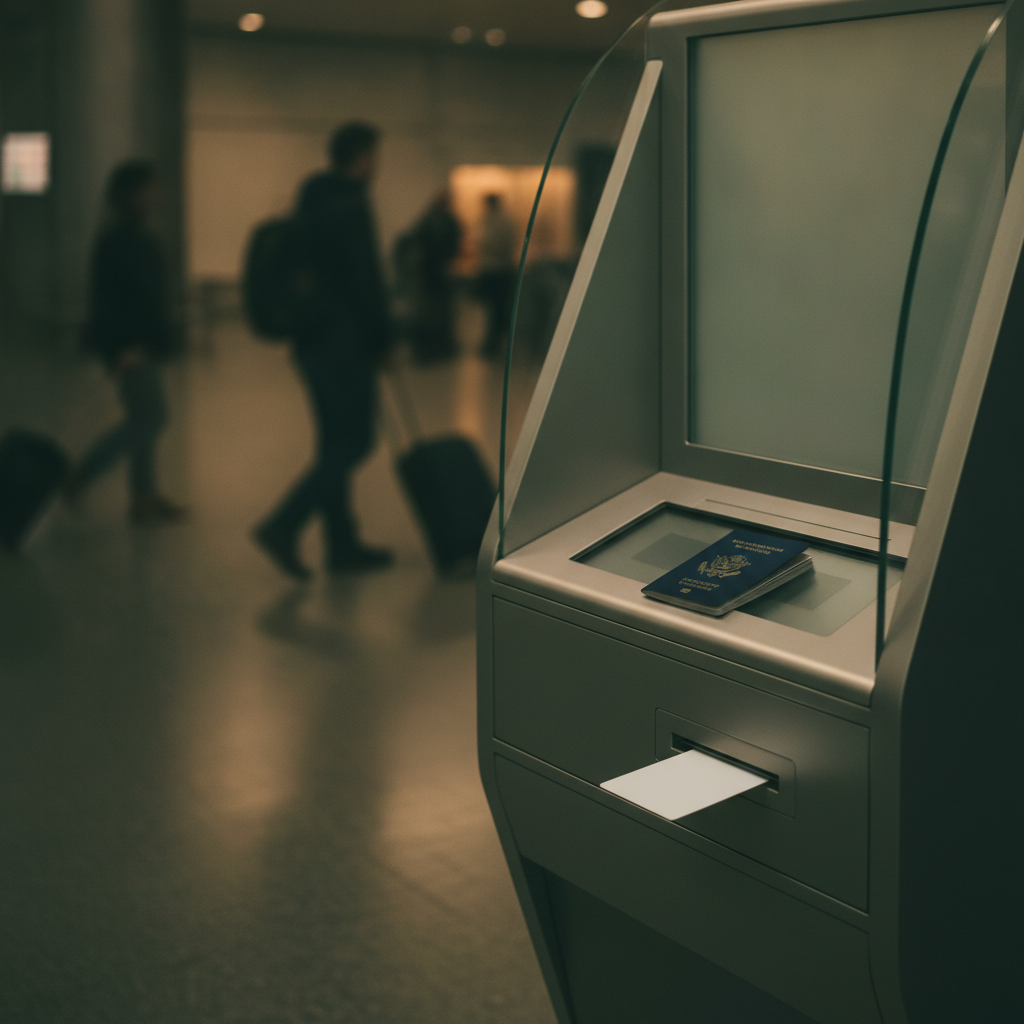
Step out of arrivals at Incheon Airport, and there used to be a line for currency exchange. These days that line is shorter. Instead, travelers stand at an unmanned kiosk, scan a passport, feed in cash, tap through a few screens. A few minutes later they are holding one card — a card that exchanges money, pays for things, and rides the subway. The trouble is that in the moment a single card seems to solve everything, few people actually know what it does and does not do.
The kiosks sit at Incheon Airport T1 and T2, Gimpo Airport, Jeju Airport, at major subway stations, in hotels, and in tourist districts like Myeongdong, Hongdae, and Gangnam. A passport is enough to register on the spot, or you can reserve online ahead of time. First-time registration costs 6,000 KRW; replacing a lost card costs 4,000 KRW. Neither fee is refundable.
The real problem does not show up at the kiosk — it shows up afterward. Money exchanged there loads onto the card's 'shopping balance,' which works at restaurants, cafes, taxis, and shops, but not at a subway gate. Riding the subway or bus requires a separate 'T-money balance,' and the two do not automatically talk to each other. You either top up T-money with cash at a convenience store or ticket machine, or transfer from the shopping balance inside the app — and that transfer only runs one way. Money moved into T-money cannot be moved back.
The reason is straightforward. WOWPASS is a prepaid card issued by a private fintech company, not a government body, and T-money is a completely separate transit-payment system run by a different operator. The two are layered onto one piece of plastic, but behind that plastic they keep separate ledgers. It looks like one card. It functions like two wallets.
In practice, here is what to do.
- Register with your passport at any kiosk, airport or city, and feed in cash to fill the shopping balance. There is no exchange fee, but limits apply: 1,000,000 KRW per single exchange, 2,000,000 KRW per day, 10,000,000 KRW per week.
- If you plan to use the subway or bus, top up the T-money balance separately as soon as you arrive. Travelers who put this off often find themselves short right when they need it most.
- The card works only at in-store IC terminals. It cannot be used for online shopping or in-app payments.
- Whatever is left at the end of the trip can be withdrawn as cash — up to 100,000 KRW per withdrawal, with a 1,000 KRW fee each time, and only after registering in the app and authenticating with an 8-digit code at the machine. What comes out is Korean won only. There is no converting it back into dollars or yen.
Before heading to the airport on your last day, check the shopping balance and the T-money balance separately, so nothing is left stranded at the last minute.
What this card solves is clear enough: it cuts down the time spent hunting for exchange counters and the number of separate payment tools a traveler has to carry. What it does not solve is just as clear. The moment you try to treat the two balances as one, or want your leftover money back in your own currency, you run into the edges of what this card actually is. The shorter line at Incheon is proof of real convenience — and proof that a new kind of attention is now required in its place.
Lost something in Korea?
We help travelers recover items left behind at hotels and other locations in Korea, and send them anywhere in the world.
Find my item