TRAVEL NOTES / NO. 022
SUNDAY, SEPTEMBER 6, 2026
Travel Problems · 3 MIN READ81
At the airport telecom counter, a choice you have three seconds to make
Pocket wifi, physical SIM, or eSIM — you don't need to understand the tech, just how many people are traveling with you.
By Find to Send Editorial
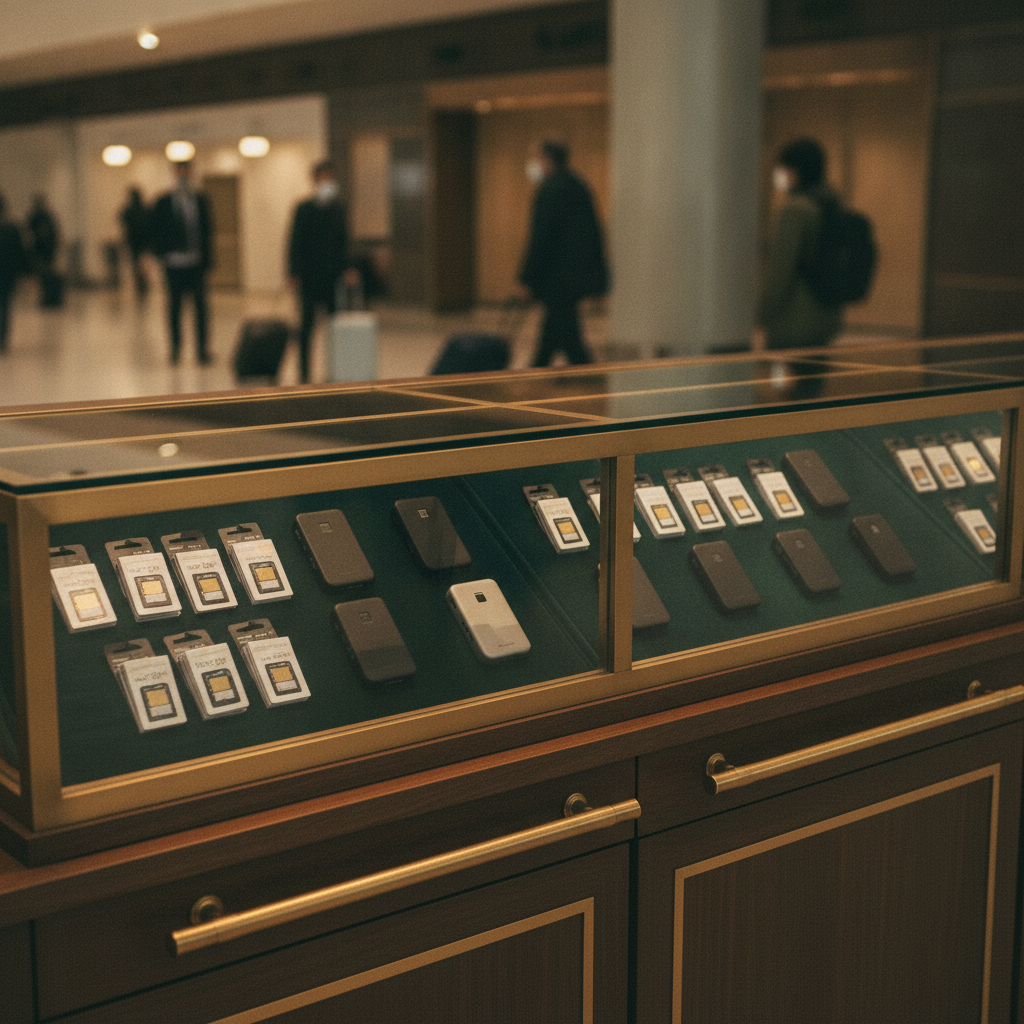
The moment the arrivals door slides open, it isn't the baggage belt that catches your eye first — it's the telecom booths. Relief at a short-looking queue lasts only seconds before staff ask, "Pocket wifi, or SIM?" Standing between two words you didn't know an hour ago, you feel the person behind you shift their weight, waiting.
The scene at these booths looks the same everywhere. Travelers stand with a suitcase parked at their side, passport in one hand, phone in the other, scanning QR codes while staff repeat the same instructions on loop. When you hear the next person's suitcase wheels roll slightly forward behind you, the time you have to think shrinks further.
The real problem is that three options that sound almost identical are impossible to fully understand in that brief window. Each booth explains them slightly differently. Most people end up copying whatever the person ahead chose, or simply agreeing to whatever the staff recommends.
The truth is these three work on fundamentally different mechanisms, which is why they suit different situations. Pocket wifi is a single device broadcasting its own wifi signal, so multiple phones or laptops can connect to it at once — but you have to carry the device separately, and if its battery dies, everyone loses signal together. SIM and eSIM work the opposite way: the phone itself holds the carrier connection, so only one person can use each device, but there's nothing extra to carry. The only difference between the two is that a SIM is a physical card you swap in, while an eSIM is set up entirely through an app or QR code.
So the decision rule is simple. If you're traveling as a group sharing one map or translation app on one screen, a single pocket wifi saves both data and luggage space. If you're traveling solo, or your group frequently splits up, a SIM or eSIM per person causes less friction. Choose eSIM if your phone is recent enough to support it, or SIM if you want the more certain, older-fashioned option.
Decide before you land — on the plane or during a layover — rather than under the pressure of that short queue.
So when the staff ask again, the real answer was never about data volume or brand. It was always about how many people are sharing that one screen today.
Lost something in Korea?
We help travelers recover items left behind at hotels and other locations in Korea, and send them anywhere in the world.
Find my item