TRAVEL NOTES / NO. 002
THURSDAY, AUGUST 20, 2026
Korea Travel · 5 MIN READ196
Why a waiter chases you into the street to return your tip
Korea has effectively no tipping culture — travelers often learn this only after a server runs after them to hand the money back.
By Find to Send Editorial
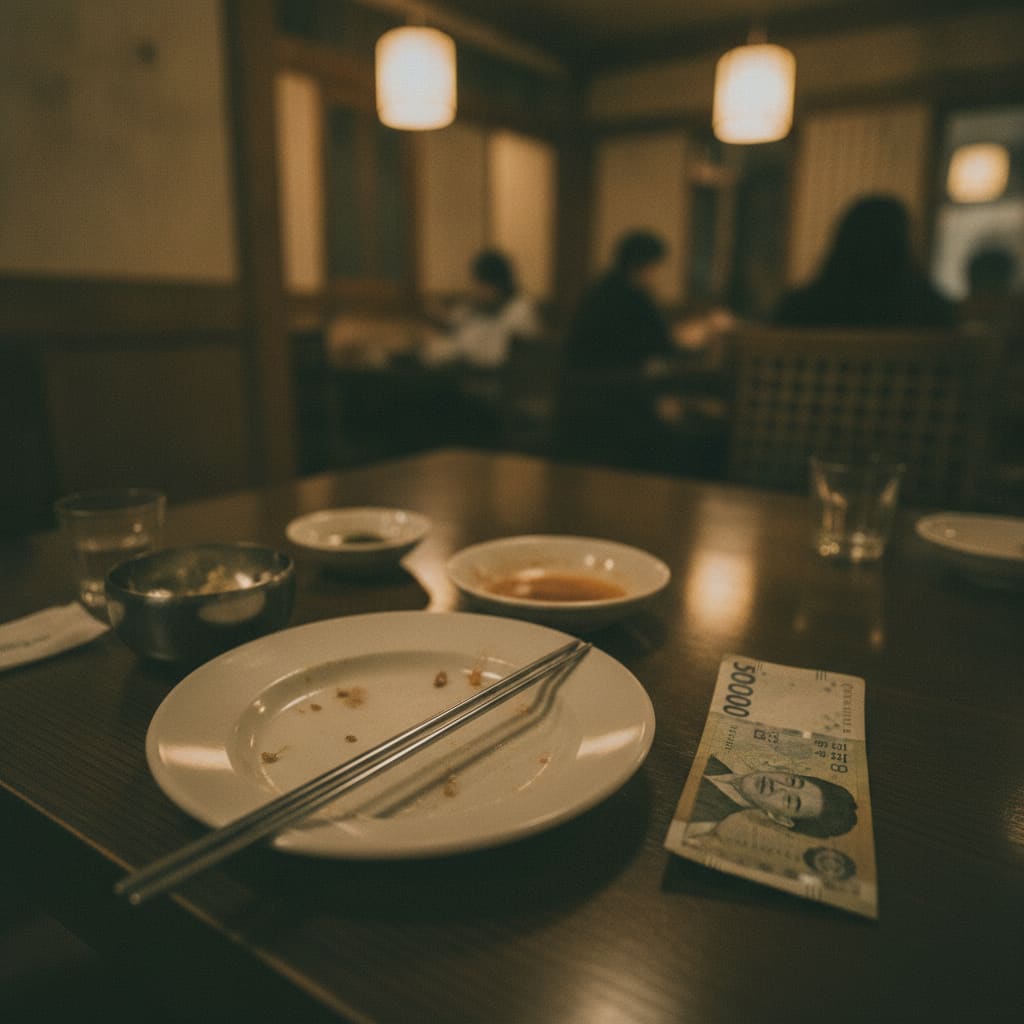
You finish dinner, slide a few bills onto the receipt tray, and step out onto the street. A few paces later, quick footsteps close in from behind. An employee in an apron, slightly out of breath, holds out the cash. "Sir, you left this behind." You start to explain that you meant to leave it — but something in the employee's face tells you this isn't a simple misunderstanding.
For travelers from the US or Europe, this scene feels backwards. Leaving a tip is supposed to be a gesture of thanks, the final note of a good meal — not something to be chased down and returned. Yet in Korea this happens often enough that it's almost more surprising when a tip is simply pocketed without comment.
This small drama repeats quietly across Seoul's restaurant streets every evening. At the counter there's usually just a card terminal and a receipt printer — no tip-entry screen, no line on the receipt for gratuity at all. Even when a clerk turns the payment screen toward you, the only numbers on it are the food total and tax. A traveler reaches into their wallet out of habit and leaves some cash on the table, and in that instant the employee's mind registers only one thing: the guest left something behind.
The trouble is that this can't just be laughed off as a quirky cultural difference — it leaves a small, persistent discomfort. When the service genuinely felt good, there's no obvious way to express that. Leave money and someone runs after you to return it; leave nothing and there's a nagging sense you've skipped some expected courtesy. And it doesn't end after one meal. A taxi driver waves off change and insists on counting it back into your hand; a hair salon delivers a great cut with no moment, no gesture, no slot where a tip could even go. This friction recurs throughout a Korea trip not because the traveler is doing something wrong, but because tipping was simply never built into the system to begin with.
Look at how Korea's restaurant and service pricing actually works and the reason becomes clear. In restaurants, cafes, hair salons, and taxis, service charges and tax are already folded into the listed price. The 15,000 won printed on the menu is the final number — it already accounts for the labor of serving you, and there was never meant to be anything for the customer to add on top. American-style tipping grew out of a system where servers' base wages were kept deliberately low, with tips expected to make up the difference. Korea's service industry developed the opposite way, building wages around minimum-wage and salary structures that already compensate service labor directly. As a result, there was never a reason to build a tip line into a receipt, and payment terminal software here was never coded to accept one.
Dig a layer deeper and there's a social reason too. In Korean social norms, taking money from a customer beyond the agreed price can read as slightly inappropriate — almost as if it implies "the listed price wasn't enough to properly serve you," or worse, as if the business is quietly asking for more than what was agreed. So an employee's instinct is to interpret money left on a table not as a tip but as something the guest simply forgot. This isn't one worker's personal quirk; it's a reflex shared across the whole industry.
There are exceptions, though. At upscale hotels, where bellhops carry luggage or concierges handle special requests, small tips are sometimes accepted — these are roles that deal with international travelers regularly, in settings already shaped by global hotel-chain service norms, where both sides understand tipping isn't rude. Even there, though, a tip is never expected or required. Service quality doesn't change based on whether you tip, and tipping doesn't buy you any special treatment either.
So the practical approach for a Korea trip looks something like this. First, at restaurants, cafes, salons, and in taxis, don't bother preparing tip money at all — treat the number on the receipt as the true final number, full stop. Second, if the service genuinely impressed you, words carry more weight than cash; a simple "the food was great, thank you" said at checkout often lands better than money ever would. Third, if you want to hand a bellhop or concierge at a nice hotel a small bill for carrying bags or handling a special request, that's fine and won't be seen as rude — just don't insist if they politely decline. Fourth, if you do accidentally leave cash behind and someone runs after you, remember this is the standard reflex here, not a misunderstanding you need to untangle; you can explain "it's a tip" on the spot, but if they keep declining, the easiest thing for everyone is simply to take it back. The whole exchange usually resolves in a few slightly comic, entirely good-natured seconds.
That evening, folding the returned bills back into your wallet, a small realization settles in. The absence of tipping doesn't mean there's no way to say thank you — it means the thanks was already built into the price, and into the words you're free to say instead. At the next restaurant, you leave without any bills on the table at all, just a quiet "that was delicious" on your way out.