TRAVEL NOTES / NO. 011
THURSDAY, AUGUST 27, 2026
Luggage · 5 MIN READ193
Why That Power Bank Can Never Go in Your Checked Bag
One quietly swelling lithium cell in a cargo hold was enough to rewrite the rules for every flight
By Find to Send Editorial
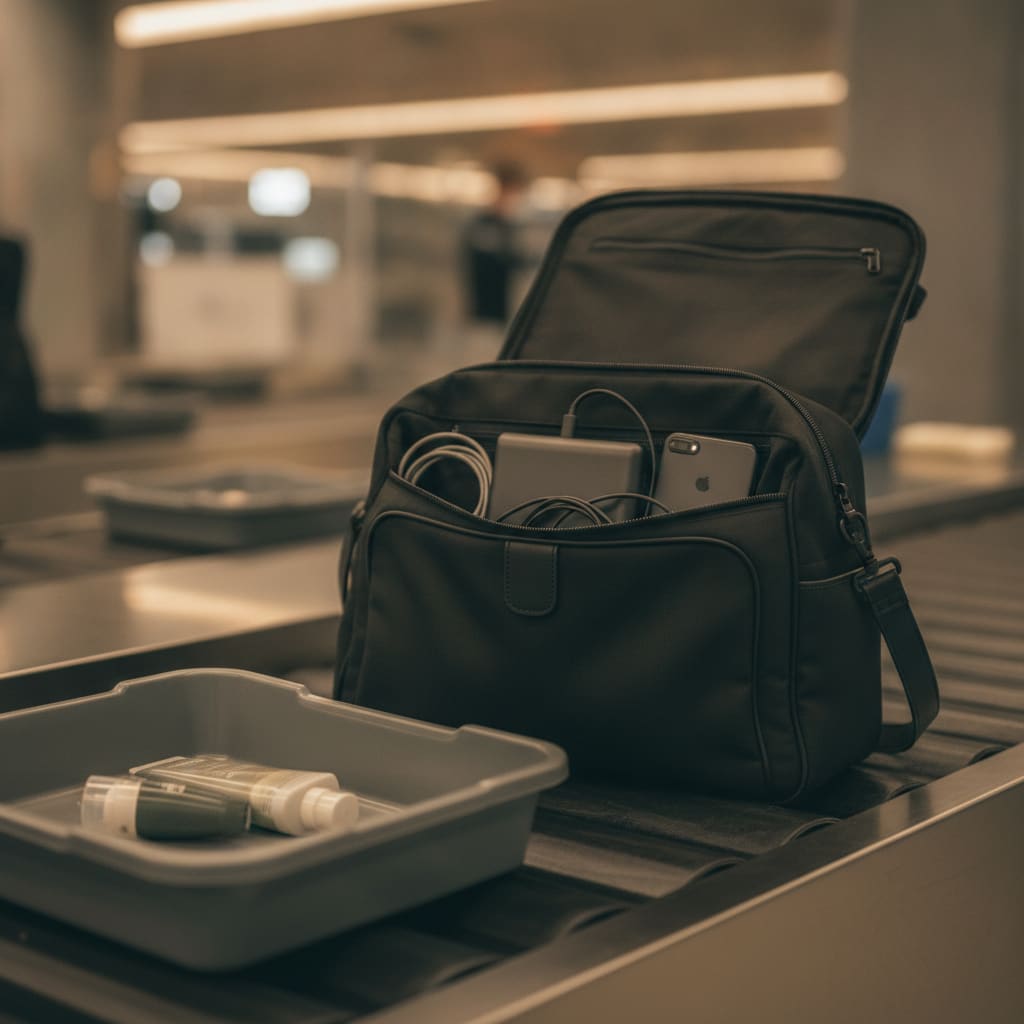
Right as you're about to lift your suitcase onto the check-in belt, the staff member raises a hand and stops you. "Do you have a power bank in your bag?" For a second your mind goes blank. You're fairly sure you packed one somewhere, but you can't quite recall which pocket. You feel the line behind you watching, and your hands fumble a little too fast unzipping the case.
For most travelers this moment feels unfamiliar. At home, packing a spare battery never seemed worth a second thought. But at the airport, things are different. A spare battery tucked into a laptop charger case, a phone power bank, even the battery inside an e-cigarette — none of these can ever go into a suitcase headed for the cargo hold, and many travelers only learn this on the spot.
At the security scanner, the officer's eyes catch battery shapes with unusual speed. Cylindrical or flat, the moment something marked lithium appears on the X-ray screen, their hand pauses over the controls. The belt behind you keeps grinding forward, a radio crackles with a short confirmation, and somewhere in the next line someone sighs while repacking their bag — all because of a single battery. It is a common enough scene that it barely draws attention from anyone except the person it's happening to.
The trouble is that the rule itself rarely feels intuitive from where a traveler is standing. Some airlines allow the laptop itself in checked luggage but not its spare battery — so why separate the two? Power banks are fine to carry on, but why are larger batteries treated differently, and where exactly is the capacity cutoff? Every airline seems to phrase it slightly differently, which makes the rule easy to misread even when you've tried to look it up in advance.
What makes it worse is that most people discover this only after they've already packed and are standing at the counter ready to check their bag. Being told to unpack a battery at that point means opening the suitcase again, right there, in front of everyone. During the already time-pressured process of departure, those few minutes stretch out longer than they should.
The reason behind the rule comes down to fire risk. Lithium batteries can undergo something called thermal runaway if they're damaged internally or exposed to pressure, impact, or high heat. Once that reaction starts, the battery generates its own heat, the temperature keeps climbing, and it can eventually ignite or explode — a chemical property built into the battery itself. The cargo hold is the problem here: it is a sealed compartment that no one can physically reach during flight. In the cabin, a flight attendant or passenger could spot smoke or heat immediately and respond with an extinguisher, but a fire starting in the hold would likely go undetected for critical minutes, and putting it out is close to impossible from where the crew sits.
This is why international aviation safety standards, including those set by IATA, require lithium batteries to travel only as carry-on items, never inside checked luggage. The logic is simple: keeping them in the cabin means a person is present to notice and react the moment something goes wrong. Because this standard is set at the level of international agreement rather than by any single airline's internal policy, it applies almost identically no matter which country or carrier you're flying with — which is why a security officer at Incheon and one at any airport abroad will give you the same instruction the moment they spot a battery in the wrong bag.
A few concrete steps make this far less stressful when you're actually packing.
- Before you start packing, gather every power bank and spare lithium battery — camera batteries, drone batteries, anything similar — and decide where they'll go in your carry-on first, rather than tucking them into the checked suitcase and having to fish them out later.
- Inside your carry-on, keep batteries together in a separate pouch or zip bag rather than scattered among other items, since security staff frequently ask to see them separately, and having them ready to pull out saves time at the scanner.
- Remember that devices with batteries built in, like phones or laptops, are usually fine in checked luggage in most cases, but any spare, detached battery must travel in the cabin regardless — the device and its spare battery are often treated under different rules.
- If a staff member flags a battery inside your checked bag at the counter or scanner, there's no need to panic — simply open the case on the spot, move the battery into your carry-on, and continue on; most airports have space set aside near check-in specifically for this, and the whole process usually takes only a few minutes.
- If you're carrying a high-capacity power bank or spare battery, check your airline's watt-hour (Wh) limit in advance, especially for anything approaching or exceeding 100Wh, since some carriers require prior approval or won't allow it at all above certain thresholds.
The staff member who raised a hand at the counter wasn't trying to make things difficult — they were simply upholding a rule built to prevent something invisible from happening inside a compartment no one can reach mid-flight. The next time you pack a suitcase, deciding in advance which bag the power bank goes into is a small habit that quietly removes those few minutes of scrambling.
Hauling bags between stops?
You can send your luggage ahead — hotel to hotel, or between your hotel and the airport. We confirm the route and price with our partner first.
About Luggage ConnectionRead next
OCT 23, 2026 · Luggage
Incheon Airport Luggage Storage: Locations and Fees Vary by Source, Check Before You Go
OCT 14, 2026 · Luggage
How do you avoid grabbing the wrong suitcase at baggage claim?
OCT 5, 2026 · Luggage