TRAVEL NOTES / NO. 039
WEDNESDAY, SEPTEMBER 23, 2026
Airport · 5 MIN READ182
One lighter in the tray can slow down your whole departure
Banned items are confiscated on the spot at security — here is what to know before you pack.
By Find to Send Editorial
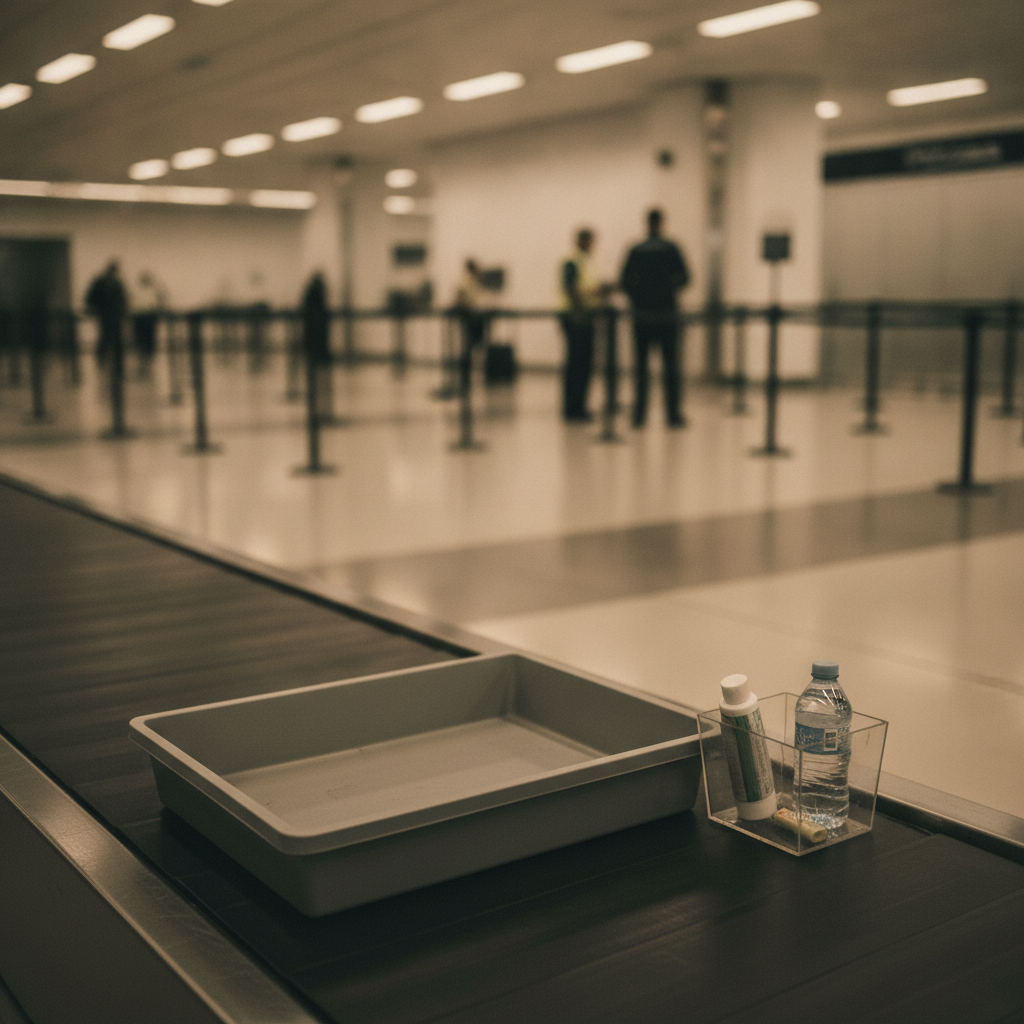
The departure line had moved faster than expected, and there was a small sense of relief settling in. Bag on the belt, jacket off, laptop out — following the familiar rhythm of airport security — when an officer raised a hand and stopped the conveyor. A gray tray slid back out. Inside it sat a small lighter that had been useful all through the trip. "This isn't allowed," came the short line, and within seconds the lighter disappeared into a clear bin beside the scanner.
It was a minor object, but the moment of awkwardness was not minor at all. The line behind kept moving, the boarding time was fixed, and there was neither time nor room to argue. All that was left was to nod, gather the bag, and hurry along.
The scene in front of any airport security checkpoint looks much the same everywhere. Gray plastic trays circulate endlessly while people bend to remove belts, watches, and liquid pouches. Officers watch the X-ray screen with flat expressions, until a particular shape appears — then a finger taps the screen and a glance passes to a colleague nearby. The belt stops, and the bag's owner watches their belongings get opened again in front of everyone.
What gets caught most often are lighters, small knives, and sprays. To a traveler, these are ordinary things — a lighter for a smoke, a small knife used for camping or hiking, a can of perfume or hairspray. But from the other side of the checkpoint, all of these fall into categories tied to fire, flammability, or pressurized containers. The problem is that most travelers never check these rules precisely before departure. Packing a suitcase, an item gets tucked into a pouch without thinking, the pouch goes into the carry-on, and its fate is sealed the moment the bag is packed.
What makes it worse is that once confiscated, there is almost no way to get the item back. A checkpoint is not a storage facility — it exists to remove a risk immediately. Whether it is a cheap lighter or a pocketknife carried for years, once it goes into the bin, that is the end of it. The flight is scheduled, there is no time to go back and check the bag, and the traveler simply has to accept the loss and move toward the gate.
This keeps happening because of how the mechanism of airport security actually works. Carry-on screening is a real-time safety judgment governed by international aviation security regulations and each country's aviation authority guidelines. Items like lighters, blades, and pressurized cans are judged capable of causing fire or accidents in the sealed, high-altitude environment of a cabin, so they are banned as a category, without exception. Security officers have neither the authority nor the time to weigh the intended use of each individual object — once a shape matching a banned item appears on the X-ray, it is removed.
Another key point is that the rule treats checked baggage and carry-on baggage differently. The same lighter, if packed inside a suitcase going into the cargo hold, is often permitted (though airlines and countries may cap quantity or type), while the same item in a carry-on bag gets confiscated. This distinction is not really about the danger of the object itself, but about whether it sits in a space people can access during flight. The cargo hold is sealed and inaccessible to passengers or crew mid-flight, so the same item becomes acceptable under those controlled conditions.
Avoiding this problem is simple in principle — but timing is everything.
- Before packing, check the list of items banned from carry-on — lighters, knives, sprays and similar — since airlines and departure-country authorities usually post an updated list on their official pages.
- If such an item must still travel with you, move it into checked luggage before the suitcase is handed over, sorting it out at home or at the hotel rather than reopening bags at the check-in counter.
- If moving it isn't practical, or the item is nearly used up anyway, it is often better to simply discard it before heading to the airport — a half-empty spray or a spent lighter on the last day of a trip is rarely worth the trouble of trying to save.
- If it gets caught at security anyway, most airports offer no time to return to check-in and re-check the bag, so accepting the loss quietly and continuing through the process is the realistic choice — arguing or delaying only shrinks the traveler's own buffer before boarding.
- When there genuinely is time to spare, some airports have mail-forwarding counters or storage booths near security, so checking the airport's layout in advance can help — though not every airport offers this, so it should not be relied upon.
Looking back at that gray tray, the real issue was never the lighter itself. It was a small gap in habit — not checking, until the very last moment of packing, what exactly was not allowed. Next time, before zipping the suitcase shut, opening that one pouch again for one more look. Those few seconds of checking are what protect the next few minutes at the checkpoint.
Getting to or from the airport?
You can request a pickup or drop-off between Incheon or Gimpo airport and Seoul or nearby areas. We confirm the vehicle and price first.
About Airport Transfer